Felicity Wright

Travels

  • Home
  • Blog
  • About
  • Circling: A Spiritual Odyssey
    • Sample Sermons
  • Other Works
    • In the Supreme Court of Universe
    • Whimsical What-Nots
    • The Proof behind Traveling Mercies
  • Doggerel and Other Animal Enchantments
    • Kyrie’s story
    • Meet Gabriel
    • Meet Goober
  • Contact

Celebrating a Life Well Lived

October 25, 2011 By Felicity Wright

On Thursday night at 10:00 PM Eastern time, PBS will feature a fabulous movie as part of their “Independent Lens” programming. Written by Eric Neudel, the film is “Lives Well Lived,” about the disability rights movement; it features, among others, my cousin Frederick Allen Fay, who died last month at his home in Concord, MA.  It was one of my greatest honors to be asked to lead the worship service for him, for he changed the lives of many — including mine.

Here is a portion of my remarks:

How does one do justice to a man who is so much larger than life? How does one do justice to a man who spent half of his life flat on his back and yet was more powerful than a phalanx of soldiers?

As we ponder that, I need to tell you that, as a child, Fred wasn’t my favorite cousin.  He was a few months older than my brother Peter, which meant that both of them were two years older than I. Peter and Fred were into sports and girls and … teasing me.   I really liked Bruce and Margaret and Jean and Aunt Janet and Uncle Allan and their wonderful dog Bandit. Fred was OK, but no, he wasn’t my favorite.

That all changed after his accident.  Or, I should say, after he transformed his life – and mine, and many others – following the accident.  He was not only my favorite, he became a personal hero. Except that he didn’t like the idea of being put on a pedestal.

Now, in my life, I’ve been fortunate to meet – if only in passing – Desmond Tutu and Martin Luther King, Jr.  And I’ve read a lot about Jesus and Gandhi, Mother Teresa and Nelson Mandela, the Dalai Lama and Franklin Delano Roosevelt and others who changed the world. Speaking for myself, Fred is way up there with these other luminaries – so much larger-than-life, so able to make wise and loving choices especially when they’re difficult or unpopular. What is it that they have-or-think-or-believe that gives them the faith or the vision or whatever-it-is to become pioneers in courage?

Ever since Trish and Derick asked me to develop and speak at this service – one of the great honors of my life – I’ve struggled to discern what makes a hero. In addition to Fred and Jesus and Gandhi et al., I’m thinking about 9-11 and the firefighters in New York and the airline passengers in Pennsylvania who looked death in the eye and decided that a brave life was more to be treasured than a long life.  So, for two weeks, Fred, 9-11, hope, and heroism have all been spinning together like the makings of a milkshake in the blender of my mind.

It took a while, but I finally “got” it. Some of it has to do with opportunity, but there’s more.  I finally “got” why Fred, powerless by the world’s standards was the most powerful man I ever had the privilege of knowing up-close-and-personal. I finally “got” what underlay Fred’s “can do” attitude even when he – physically at least – “could not.”  I finally “got” why my young and rambunctious children preferred to spend the day at home with Fred than out sightseeing or going to the playground or a movie.

Namely this:  what Fred had in common with Jesus, Gandhi, FDR, MLK, the Dalai Lama, Mother Teresa, Desmond Tutu, Viktor Frankl, and other champions of justice has everything to do with power – specifically, the use and misuse of power.

It is often the case that someone abused as a child grows up to become an abuser himself. Physically and emotionally, one inflicts the injury upon one’s children that was inflicted up them. That goes for groups and countries also: a few crazy Muslims that were oppressed by their US-supported governments felt justified in lashing out against their tormenters – to whit 9/11.  We, the most powerful country in the world, then felt victimized and retaliated against those countries that harbored the abusers. It’s a perpetual seesaw of victim – abuser – victim – abuser…

And if it’s not the seesaw of violence, it can be the less obvious but equally destructive iron triangle of victim-abuser-enabler.  People involved in Al-Anon or other codependency programs know how easy it is to accommodate those who are addicted or abusive. When we’re caught in that victim-abuser-enabler triangle – and most of us are at one time or in one way or another – we identify ourselves by our lack of power.  We think of ourselves as “less-than” – less-than-perfect or less-than-powerful in a cruel and unjust world, whether because we are black, female, physically challenged, of the wrong religion, or children of alcoholics, or the child who wasn’t the favorite, or one who lacked the advantages of his peers… well, you get the idea.  We self-identify by what is missing – our lack of influence and power. We don’t recognize, embrace, or live our God-given power in healthy ways.  When we do claim our power, it’s often at the expense of others, making them into victims or enablers.

But not Fred.  Not Jesus or MLK Jr. or Mandela or FDR or the other truly great men and women in history. They never self-identified as “less than.”  They never got trapped in the vicious triangle of abusive power. What makes Fred so remarkable is that he never felt sorry for himself; he owned his power without oppressing others. Further, it upset Fred when folks put him on a pedestal because that necessarily meant that he was “more-than,” and the other was “less-than.”

But this only half the equation. Too often, we think of power as a limited resource, like money and food, without enough for everyone to be comfortable.  For me to enjoy as much power as I want, you need to have less.  It’s a dog-eat-dog world – right?

This is what I realized while thinking about Fred, Jesus, Gandhi, et al. – true heroes declare their power AND teach others how to claim theirs.  They empower those who think of themselves as “less than.”

So where do we go with this?  Before answering that question, I’d like to share Fred’s response when I asked how he managed to stay positive and playful.  (I was feeling sorry for myself after some life challenges and wanted to know how Fred avoided self-pity.) “How do you do it,” I asked.

“Granddaddy,” said Fred. “Huh?” I replied, to which he continued: “When I came out of the surgery and realized I was a paraplegic, I thought about our grandfather after that terrible car accident that broke his pelvis when he was 83.  No one expected him to live, or, if he did, it would be in a wheelchair. But other people’s assessments of what Granddaddy could not do didn’t stop him from doing what he could.  It took six months, but he was up and walking with the help of braces and special shoes.  He sometimes used a cane, but rarely. He never stopped hobbling out to pick blueberries, or make a fire, or serve people food and drink.  He never complained, and he never stopped enjoying life.  So whenever I feel sorry for myself, I remember how much fun Granddaddy had in living and how much he enjoyed people and vice versa.  So I consciously work on being grateful and it brings joy.  I wouldn’t change my life for anyone’s.”

In closing, Stephen Covey talks about the four aspects of a quality life: living, loving, learning, and leaving a legacy.  The legacy Granddaddy left was a can-do spirit and a joy in living regardless of physical challenges. Fred’s legacy is all that plus an awareness that we don’t need to be trapped in a victim-abuser-enabler triangle.  We can embrace our power and we can give it away.  As Granddaddy was a transforming image for Fred, so was Fred for me – and I hope you.  By sharing our gifts and power with others, we, like Fred – and Jesus and Gandhi and the others – can and will change the world.  And the saints and heroes in heaven and on earth will cheer.

If you’d like to read more about Fred, please go to my brother Peter’s website (http://www.wrightslaw.com/info/memory.fred.fay.htm) or do a Google search — you’ll be amazed at the range of his influence.  Though physically limited to a wheel bed in a Boston suburb, his moral and spiritual presence has been felt throughout the world. Truly, we give thanks to a life very well lived.
A Hero Dies … and Lives On and On…

August 29, 2011 By Felicity Wright

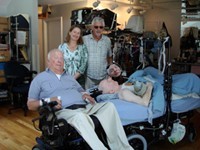
My cousin Frederick B. Fay died on August 20, and the world both grieves and delights. For Fred — who lived most of his life in a wheelchair or wheel bed — was a hero of great influence. If you or a friend or relative of yours with physical impairments can use public transportation to get where you want to go, thank Fred. If you are grateful for public buildings that are now handicapped accessible, thank Fred. If you are able to live a life of quality despite physical limitations, thank Fred. If you believe that ALL Americans should be able to enjoy our country’s blessings — regardless of race, age, gender, or physical capabilities — thank Fred.

As we consider the heroes of 9/11 (about which I’ll be writing in the next week), let us also give thanks for the heroes we know, up close and personal. These are the heroes who change our everyday lives by the courage they show and the lives they improve. They are soldiers and firefighters and doctors and teachers … and cousins. They are people who, by the power of their passion and the force of their “irrepressible optimism” (a phrase commonly used to describe his indomitable spirit) break through all of the usual crud and improve the world in dramatic ways.

My brother, Peter Wright (an attorney specializing in special education law) and his wife Pam are more skilled  at updating websites and blogs and they have  posted several articles that tell of the power of Fred.  (See below.) Or you can wait until October 27 to see the film “Lives Worth Living” on PBS that will feature Fred and others in the disability rights movement.

Here are Peter’s comments:

When Fred was 17, he launched his disability advocacy career. Today Fred is widely recognized as one of the most significant leaders in the disability rights and independent living movements in the nation.

As you read this story and follow the links, you can hear Fred tell his story. 

As a teenager, Fred was an accomplished gymnast. At age 16, he fell from a trapeze and landed on his head, suffering a severe spinal cord injury. Despite his injuries, Fred was determined to live a full life. He wanted to show that a person with quadriplegia could be active, own an apartment, drive a car, get married, have children, and earn a Ph.D. In the video links below, you’ll see and hear Fred tell his story.

Fred accomplished his dreams, while also working to secure unprecedented access to civil rights for Americans with disabilities.

As a disability policy adviser to the Administration and Congress, Fred was instrumental in winning passage of Sections 503 and 504 of the Rehabilitation Act of 1973, the Education for All Handicapped Children Act, the ADA of 1990, and the IDEA of 1997.

When President Johnson invited Fred to the Rose Garden for the signing of the the Urban Mass Transportation Act 1964, his wheelchair had to bebumped up the steps – the White House was not accessible.

“Lobbying to get access for the disabled became his life’s work, achieving it has become his life’s triumph.“

At home in Washington, DC, Fred found “every single curb was like a Berlin Wall telling me that I was not welcome to travel farther than a block.” When Fred read about the new DC subway system to be built he thought “Why don’t they build it so that everybody can ride it?…”

Fred Fay with Elmer Bartels, Alison GilkeyFred’s life proves that one man can change the world, even though he has to lie flat on his back just to stay alive.

videoLives Worth Living – In this trailer, Fred as he tells you about his life after a devastating spinal cord injury, and his alliance with a small group of dedicated activists who formed the Disability Rights Movement and helped drive the nation towards equal rights.

An Incomparable Tinkerer

Fred “assumes no barriers in how innovative he can be in designing the technology in his environment.” – Judy Brewer, Director of the Web Accessibility Initiative of the World Wide Web Consortium.

Fred was a pioneer in the development of assistive technology and has been instrumental in the development of adaptive computer technology. For millions of people with disabilities, Fred’s innovations have provided access to the world around them.

UC Berkeley’s Bancroft Library has recorded the stories of individuals who have made significant contributions to disability rights and the independent living movement. Read more about Fred here…

Fred Fay: Community Organizer and Advocate for Equal Access and Equal Rights

(This paragraph revised on 8/20/2011) If you would like to send Fred’s family a note of thanks, please send an email to:

thankyou.fred | at | wrightslaw.com

Considering Grace

May 29, 2011 By Felicity Wright

After the final no there comes a yes

And on that yes the future world depends.

No was the night. Yes is this present sun.

Wallace Stevens, “The Well Dressed Man with a Beard”

I just returned from New York City, where I spent a delightful – and challenging – day with my dear friends and literary agents Michael Larsen and Elizabeth Pomada. Ours is a special relationship where we can be direct and loving, knowing that honest criticism comes only with respect. (I hope that you have people like Michael and Elizabeth in your life, for they are a gift.)

In my case, they are enthusiastic about my writing and supportive of my book In God We Tryst. But Michael (author of How to Write a Book Proposal, now in its third edition and the award-winning blog http://sfwriters.info/blog) emphasizes that publishing is about writing and promotion.  And so, he encouraged me to become more proactive about public relations, specifically developing and offering workshops, writing blogs more frequently, and encouraging people to sign up and comment on them.  (Please do so, if you haven’t already; publishers need proof of a ready “audience” of interested people who will purchase what they print.)

Then, upon reading my latest proposal, he resonated with the notion of “being an agent of grace,” one of the themes of my book.  Thinking this is a message the world needs, he encouraged me to be more explicit in explaining how we recognize grace and what we need to become agents of grace.

And so now the challenge is on:

  • How do you define “grace”?
  • How do you recognize grace – either God’s grace or another’s?
  • Looking at Wallace Stevens poem, what is the “yes” upon which the future world depends? – Is it “grace” or something else?  Does it come from God or another source?

Hopefully this blog can become a discussion of grace – how we define and recognize it as well as how we become agents of grace. I welcome your thoughts.


Jesus Believed in … WHAT???

April 26, 2011 By Felicity Wright

This was my Easter sermon at The Park Church in Elmira, NY — the church of the early abolitionists, Thomas K. Beecher, and Sam and Annis Ford Eastman, and of people who understand the radical message of Christ’s all-welcoming love.


Taking a lesson from Howard Baker, eminent politician and ranking Republican on the panel investigating Richard Nixon – the question is: “What did he know and when did he know it?”

Nixon protested that he didn’t know about the Watergate break-in until a year after it happened. But when evidence surfaced that he was involved from the onset, it wasn’t long before he chose to resign rather than be impeached.  Now, it seems to me that if the question of what Nixon knew and when he knew is was a critical one for U.S. politics in the 20th century, the question of what Jesus knew and when he knew it has been a critical one for … let’s see … almost 2,000 years!

What Jesus knew and when he knew it might also clarify the bigger issue of what he believed in. Why would he allow himself to go to the cross with nary a protest? If we can determine what Jesus believed in it might help us determine what we should believe in.

Did he, for example, believe that he was the one and only true son of God?  Did he believe he would reign from heaven after death? Did he believe that 2 millennia after his death, one out of every three people would profess faith in – and often be willing to die for – the values he espoused?  In short, did he – nailed to that shameful and vicious cross – have any notion that his death would change the world for all time?

If he had an exalted sense of himself as the son of God and just a few breaths away from heavenly paradise, then, in a certain way, that trivializes the viciousness of Good Friday.  And if the horror of Good Friday is diminished, so also is the elation of Easter morning. If nothing much happened on Easter, what are we doing here?  Why are we baptizing Tristan James – why do we call ourselves Christians, and why do we make certain life decisions and not others?

Something did happen on Easter morning – something very big indeed.  But I don’t believe that it has a whole lot to do with Jesus’ bodily disappearance from the tomb. As important as that is, I question whether it is the true source of our faith.  Let’s consider the bigger picture.

Many people assume that the bodily resurrection of Jesus is the singular act that defines our faith. For them, his disappearance from the tomb on Easter morning is incontrovertible proof that he was the Son of God.  Anyone who questions the physics behind the Easter miracle is, by definition, not a Christian.

Others say that Jesus’ body was removed by stealth or that his followers concocted the story.  Some scholars note that Jesus was not the first or the last person to be resuscitated after death – in fact, we have Biblical stories of Elijah and Elisha, to say nothing of Jesus’ raising of Lazarus and Jairus’ daughter. Later, his disciples reportedly raised some people from the dead.  There were also resurrection stories in Egyptian, Greek, and Assyrian cultures circulating at the time of Jesus. So the disappearance of Jesus’ body was not the single most important fact that gave birth to the most powerful religion in the world for all known time.

Equally problematic is the idea that Jesus was a willing sacrifice for our sins.  This idea – called substitutionary atonement – posits that Jesus was a ritual offering intended to appease God from wreaking greater havoc on the rest of us.  In dying a horrible death, some people argue, Jesus took on the sins of all so that we will have everlasting life in heaven with God, regardless of our sins on earth. But did Jesus believe that he was the scapegoat for our sins?  Did he believe God to be a sadist demanding such appeasement?  — I think not.

Then there’s the idea that Jesus thought himself the son of God, which would explain his willingness to go to the cross as proof of his divinity – sort of “I double dare you….”  But I don’t believe that, mostly because – with the exception of the gospel of John, which was written much later than the others and has a decidedly Platonist influence – Jesus never calls himself the “son of God,” but rather “son of Man.” He doesn’t call himself the Messiah either, except to urge his disciples not to refer to him by that name. This suggests that Jesus thought himself fully human, fully able to suffer, fully able to die as all mortals do. So did Jesus think himself the only son of God? – Well, that notion doesn’t work for me.

Another question is what Jesus thought about the “second coming” and the “kingdom of God.” Scholars argue mightily on the issue of whether Jesus expected to return to earth in his human body, so I don’t know what to say about that.  Fortunately, there’s more clarity about the “kingdom of God,” so often illustrated by Jesus in parables.  The kingdom of God might (or might not) mean a future paradise in some far-away heaven, but it certainly does mean a loving and just world in the here-and-now.  This understanding of a generous and God-loving society undergirds Jesus’ every act and statement.

So, if Jesus didn’t believe himself the son of God, and if he didn’t believe he was the scapegoat for the sins of all mankind, and if he didn’t believe that he would come back to earth and vanquish all of his foes, and if he didn’t believe in a kingdom of God as happening only in some fairytale time and place, then what did he believe?

Writing 600 years earlier during the Babylonian captivity – a time of cruelty and dislocation for the Hebrew people – the prophet Jeremiah gives us a clue.  He assures the Israelites that God has not forgotten them and will come again in the future to restore their hopes and dreams.

“At that time, says the Lord, I will be the God of all the families of Israel, and they shall be my people…. I have loved with an everlasting love; I have stayed faithful.”

Like Jeremiah, Jesus believed in the goodness and faithfulness of God.  That’s the big one.  Jesus believed that God’s love trumps human fear and cruelty.

But was that enough?  Was that enough to give him courage to patiently endure a vicious and unjust death?  What did he believe that somehow got transferred to his followers to help them follow in his footsteps, often going to their own vicious and unjust deaths? What did he believe that changed the world for all time?

As I was struggling with these issues, I discovered a sermon by Annis Ford Eastman, one of few women ministers in the 19th century, and a revered preacher and pastor here at The Park Church.  She begins her message by considering Satan’s understanding of mankind, as expressed in the conversation between him and God in the Book of Job.  The devil’s doctrine is this: “All that a man hath will he give for his life.”  According to Satan, life – and the more comfortable the better – is man’s prize possession.

But Jesus proved the devil wrong.  People are not driven only by love of life.  It’s not all about living for me and mine. Jesus felt that if he could illustrate the kingdom of God to decent, ordinary people, they would strive to change themselves and society so to create equity and opportunity for all. He believed miracles happen whenever individuals become agents of divine love, transforming the world through generosity of heart, mind, and spirit.

Jesus believed that we want to connect with God and each other.  We are happiest when we are doing good – not for ourselves only – but for each other and for God.  He knew that, despite the fear and cowardice that gripped his followers on the day of his crucifixion, their experience of transformation in his presence had forever changed them.  It was only a question of time before they emerged from their dark caves of mortal fear to follow his lead in bringing the kingdom of God to this earth.

In short, Jesus believed that selfless love can never be crucified or buried, but will rise again and again throughout our lives, throughout the centuries, throughout the millennia, whenever people give of their own pride and their own needs – and yes, their own lives – to become witnesses for and agents of divine love.

Jesus believed in the resurrection of the dead precisely because he – and any and all of us who give our lives to God – never ever really die.  Connection with God cannot die.  Goodness cannot die.  Love cannot die.  Even when our physical bodies disappear into the ground, the love we have shared and the goodness we have birthed live on through the ages.  This is the power of Christianity.  This is the miracle of Easter.

So, in closing, what did Jesus believe?  What did he believe in so fervently that he could endure condemnation and crucifixion? What did he believe in so passionately that it would change the world for all time?

In a word, Jesus believed in God , most especially the transformative power of God’s all-embracing love.

and he believed in … us!

… and that has made all the difference. Hallelujah!


The Journey Continues…

June 15, 2010 By Felicity Wright

Hello, dear friends and readers —

I apologize for not writing for a while, but things are going crazy in my life.  I’ve been called to The Park Church in Elmira, NY to be their next pastor.   It’s a bittersweet adventure because I have so many friends (and my wonderful son) in California while I’m also excited by the prospects in Elmira.

But what else is new?  Isn’t the journey always bittersweet?

In any case, Kyrie (the dog), Eleison (the car) and I will be driving East along Rt. 80 beginning next week.  It truly will be traveling mercies as we hope to discover new delights along the way.  We have 8 days to get to Elmira, and then up to northern New Hampshire for a family reunion and my Uncle John’s 95th birthday!  Wow — a good life, well lived.  I hope that I can do as well.

I am looking for suggestions on good places to visit along the way. It’s a geography issue: where does your soul live?

  • « Previous Page
  • 1
  • …
  • 4
  • 5
  • 6
  • 7
  • 8
  • …
  • 12
  • Next Page »

Subscribe RSS

Enter your email address:

Delivered by FeedBurner

Inspirational Quotes

“I do not at all understand the mystery of grace—only that it meets us where we are but does not leave us where it found us.”

— (Anne Lamott)

Recent Posts

  • Ascending (and Descending) the Steps of Justice
  • Un-tied Nations
  • A Cure for TB
  • Letter of Mark Twain to His Mother
  • The Key to God’s Heart: Then and Now

Archives

Recent Comments

  • Sue Backus on Christmas 2017: Unexpected Gifts: “Gifts truly come in many forms…your travels took many unexpected turns, but with eyes wide open to others, your spirit…”
  • Cyn on Christmas 2017: Unexpected Gifts: “Beautiful and humbling.”
  • Suzanne Maschmeyer on Christmas 2017: Unexpected Gifts: “Deep thanks!”
  • Carol L Smock on Observations and Memories from 9-11-11 at the World Trade Center: “Thank you for this confirmation of faith and the peace that passes all understanding. I used to think that when…”
  • Carol Smock on Donald Trump: The Devil or the Holy Spirit?: “It is true that Trump forces us to examine ourselves in light of his promises and our reaction to them.…”

Copyright © 2026 · Felicity Wright All rights reserved | askmepc-webdesign | Log in